Finding information has become quite easy for students. When they do not understand a subject, they can ask AI to explain it, give examples or prepare a summary. However, when it comes to using that information on their own, problems can start to appear. Being able to follow an explanation does not necessarily mean that we have learnt the subject. We also need to see whether we can remember it and use it in a different situation.
In language classes, we can see a similar problem. A learner may know the rules of a tense and complete an exercise correctly, but still struggle to use it when speaking. So, giving the rules and checking a few answers cannot be the whole lesson. Learners need opportunities to make connections, practise and discover where their understanding is incomplete.
I think the same point deserves attention when we use AI for studying. We have many tools at our disposal, but we also need to know what to do with them. A summary can help us review a chapter. A quiz can reveal what we have missed. However, if we keep collecting summaries without checking what we have understood, we may finish with plenty of study materials and very little learning.
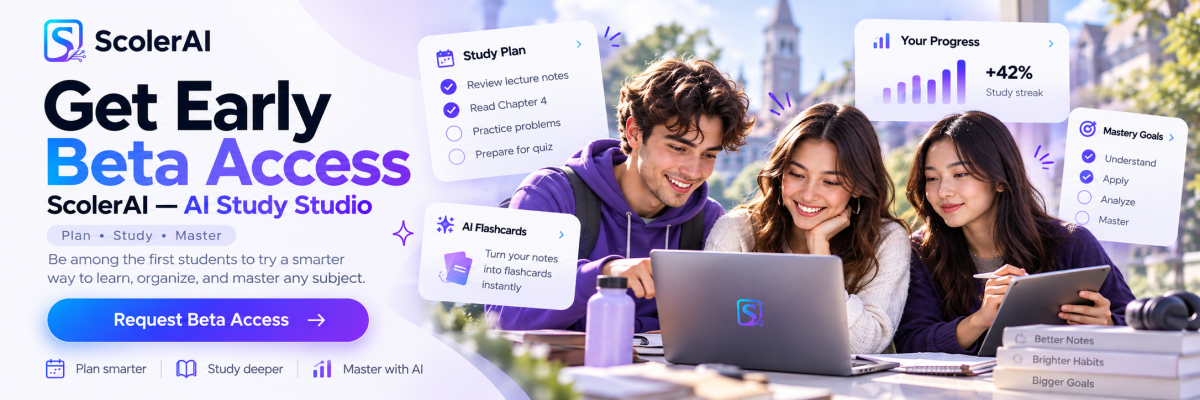
This is the idea behind ScolerAI. It is an AI Study Studio which brings study tools together and helps students use them with a purpose. Students can work with their own materials, create learning activities and get guidance from an AI Study Coach when they need help deciding what to do next.
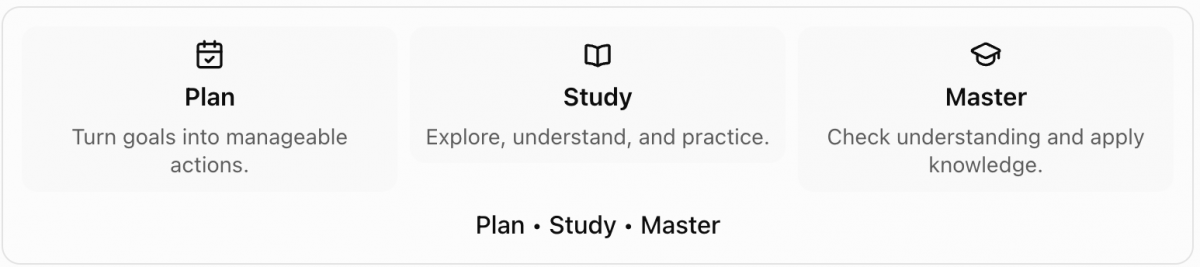
The study process is organised around three actions: Plan • Study • Master. First, we decide what we need to learn and how to approach it. Then, we work on the subject through explanations and activities. Finally, we check our understanding and return to the parts which need more work. Of course, these stages are connected. What we discover in a quiz may change what we put into our next study session.
Now, let's look at the learning principles behind these stages and how they relate to the tools in ScolerAI.
1. Bringing study tools together
Students often have their lecture slides in one place, their notes in another and their flashcards in a separate application. Besides keeping these materials organised, they have to decide which activity will help them with the subject they are studying. When there is an exam approaching, even deciding where to start can take quite a lot of time.
In ScolerAI, you can begin by describing what you need. For example, you might write: “I have an economics midterm in nine days, and I haven't started studying.” The Studio can ask for further details when necessary and help you create a suitable study plan or activity.
You can upload lecture notes, slides or textbooks and use them to prepare study sessions, quizzes, flashcards and courses. There are also tools for creating podcasts, video lessons, visual explanations and interactive applications. Having these tools together makes it easier to move from studying a topic to practising it without having to organise everything again in another application.
How does this relate to cognitive load?
Cognitive Load Theory deals with the demands placed on our working memory during learning. Working memory has a limited capacity when we are dealing with unfamiliar information. If a task introduces unnecessary demands, we may have less capacity available for understanding the subject itself. Sweller, van Merriënboer and Paas discuss these ideas in their review of cognitive architecture and instructional design (2019).
For example, when a student is trying to understand a scientific process, finding the relevant notes and moving between several tools can become an additional task. Bringing these activities together is one way ScolerAI aims to make the organisation of studying easier.
However, this does not mean that all effort should be removed. Trying to solve a problem or remember an answer can be a useful part of learning. In my opinion, the tools should be easy to follow so that students can give their attention to the subject which requires that effort.
2. Making a study plan that guides the work

"I need to study economics” is a goal, but it does not tell us much about what to do when we sit down at our desk. Which chapter should we start with? How much time do we have? Which parts have we already understood? Without answering these questions, it is quite easy to spend the available time on familiar topics and leave the difficult ones for later.
ScolerAI's Smart Planner helps students turn a broad goal into dated study tasks. These can be organised around an examination, a textbook, a new skill or a whole academic term. A task can also be connected to a study tool, so the plan gives students an activity to work on.
For instance, an economics plan might include reviewing a chapter, completing a study session and answering questions about a market situation. The AI Study Coach can consider the student's goals, active plans and upcoming tasks when suggesting what to do next. It can also help students create a plan or continue one they have already started.
Planning, checking and making changes
Zimmerman's account of self-regulated learning describes learners as active participants in their own learning (2002). They set goals, use strategies, monitor their performance and reflect on the results. His model includes three related phases: forethought, performance and self-reflection.
We can see how this works in a simple study routine. First, a student decides which topics to revise. After working on them, the student attempts some questions and checks the answers. If the definitions are clear but the application questions are difficult, the next session should focus more on applying those ideas.
So, a study plan needs to leave room for changes. Completing a task does not always mean that its learning aim has been achieved. ScolerAI's planning, practice and progress tools are intended to help students follow this process, while the Coach can help them choose a suitable next step.
3. Giving learners something to do with an explanation
A clear explanation is useful at the start of a lesson. However, we also need to find out what learners can do with it. Can they explain the idea in their own words? Can they give another example? What happens when we change part of the problem?
These questions are also useful when studying with AI. An answer may seem perfectly clear while we are reading it. The difficulty often appears when we close the explanation and try to work independently.
ScolerAI offers different ways of working on a subject. Students can ask Lesson Chat for an explanation, work through a problem with guided reasoning or begin an adaptive study session which checks understanding as they progress. They can also use their materials to create visual explanations and interactive applications.
For example, a student learning about gravity could explore a simulation, change a variable and observe the result. I would suggest taking this one step further: before changing the variable, try to predict what will happen. Afterwards, explain why the result agrees or disagrees with the prediction. In this way, the activity gives the learner something to think about as well as something to watch.
Active involvement in learning
MomChi and Wylie's ICAP framework distinguishes between passive, active, constructive and interactive engagement (2014). It draws attention to what learners are doing with the information they receive. Generating an explanation or developing an idea through meaningful dialogue involves different mental work from simply receiving information.
This is an important point for interactive study tools as well. Clicking on a screen does not, by itself, show that a learner is thinking deeply about the subject. The questions and the purpose of the activity matter.
ScolerAI's study activities are intended to give learners opportunities to question, explain and apply what they are studying. The aim is to help them become more involved in the learning process and see where they still need support.
4. Revising, checking answers and returning to difficult points
Understanding a topic today does not mean that we will remember it next week. We need to return to what we have learnt and see how much of it is still available to us. This is why regular revision has an important place in studying.
ScolerAI can generate flashcards and quizzes from students' materials. The quizzes can use different question types, including scenario-based questions which ask students to apply their knowledge. Adaptive study sessions also provide opportunities to check understanding and revisit points which need further attention.
There are three learning principles worth looking at here: retrieval practice, feedback and studying over time.
Try to remember before looking at the answer
Retrieval practice means trying to recall something we have learnt. When we read the same notes again, the content may look familiar. However, when we put the notes away and try to explain it, we can see more clearly what we remember.
Roediger and Karpicke found that practising retrieval improved retention on delayed tests compared with repeatedly studying the material in their experiments (2006). Testing, in this sense, can be part of learning as well as a way of checking it.
A flashcard offers a simple opportunity to do this. Before revealing the answer, give yourself time to recall it. If you turn over every card immediately, you will mostly be reading the information again. Similarly, when you complete a quiz, try to answer from memory before returning to your notes.
The flashcard or quiz provides the opportunity. How we use it is also important.
Find out why an answer is incorrect
An incorrect answer can tell us something useful about our learning. However, just seeing a cross beside it may not be enough. We need to understand what went wrong and what to work on next.
Hattie and Timperley discuss how feedback can help learners understand their goals, their current performance and the next steps in their learning (2007). They also explain that the effects of feedback depend on its type and how it is given.
ScolerAI's quizzes include answer explanations, and guided study sessions allow learners to return to difficult concepts. For example, if you choose the wrong answer in an application question, it is worth checking whether you misunderstood the concept or missed a detail in the situation. These two problems may need different kinds of practice.
I think this is where checking answers becomes particularly useful. We can use the mistake to decide what to do next.
Leave time between revision sessions
 It is tempting to leave revision until the evening before an exam. However, spreading the work across several sessions gives us opportunities to return to the material and check what we can still remember. Dunlosky and colleagues identified practice testing and distributed practice as techniques with broad evidence of usefulness in their review of learning techniques (2013).
ScolerAI's study plans and review activities can help students organise this work across different days. You can study a topic, return to it later and use questions to find out which parts need another look.
This is what mastery means as a learning goal in ScolerAI: developing understanding through practice, feedback and revision. It takes work, and an AI tool cannot guarantee that the subject has been mastered.
5. Choosing a suitable way to study a subject
Different subjects may call for different activities. A diagram can help us follow a biological process, while a worked example may be more useful for a mathematical problem. Sometimes, a discussion allows us to compare ideas which would be difficult to explore through flashcards alone.
In ScolerAI, students can turn their materials into several formats. Lecture notes can become a podcast for revision during a journey. A textbook can provide the basis for a course with lessons and practice activities. A difficult concept can be explored through a video lesson, a visual explanation or an interactive application. Students can also create structured notes and flashcards for later review.
Of course, having more formats does not mean that we should use all of them for every topic. We need to consider what each activity will help us do.
Words and visuals should help explain the subject
Mayer and Moreno's work on multimedia learning examines how verbal and visual information can be presented without placing unnecessary demands on learners (2003). Relevant visuals can support an explanation, but adding more media does not automatically make a lesson better.
For instance, an animation of a process can be useful when it helps us follow changes which are difficult to picture from a written description. However, if it contains too many distracting details, we may find ourselves watching the movement and missing the explanation.
The same care is needed with podcasts. Listening can be a convenient way to revisit a topic, but we should also check what we have understood afterwards. I suggest pausing and trying to explain the main point before continuing, or following the podcast with a few questions.
The purpose of offering these formats is to give students suitable options for their subject and circumstances. Their educational value depends on how they support the learning task.
6. Learning to question AI-generated information
AI can produce a detailed answer in a few seconds. However, a well-written answer may still contain mistakes or leave out an important point. Students need to know how to examine these answers, especially when they are using them to learn an unfamiliar subject.
ScolerAI includes Web Research tools which connect answers to identifiable sources. The research system checks citations against retrieved content and provides source-quality indicators. Learning Assistants also allow students to ask questions about uploaded documents and follow citations back to relevant pages.
These features can help students examine where an answer comes from. However, a citation does not settle the matter on its own. We still need to open the source, see whether it supports the claim and consider whether the information is relevant to our question. A source-quality indicator is another aid to this judgement; it cannot prove that every statement is correct.
Developing AI literacy
UNESCO's AI Competency Framework for Students includes four dimensions: a human-centred mindset, ethics of AI, AI techniques and applications, and AI system design (2024). The framework concerns the knowledge, skills and judgement students need when engaging with AI.
ScolerAI draws on these dimensions in its AI Literacy Framework. It encourages learners to reflect on their use of AI, examine sources and consider their own understanding.
In my opinion, becoming a confident AI user also involves knowing when to question an answer. We should be able to ask what evidence supports it, what may be missing and whether we can explain the idea ourselves. These habits give students a more active role in studying with AI.
7. Putting the Studio and the Coach into a study routine
Let's say you have an exam in two weeks, several chapters to revise and a limited amount of time each day. You can start by telling ScolerAI what you need to prepare and how much time you have. The Studio can help you create a study plan and suitable activities.
After uploading your lecture materials, you can use a Learning Assistant to ask questions about them. If one topic is particularly difficult, you can work through a study session or create a visual explanation. Then, you can attempt a quiz to see what you have understood and prepare flashcards for the points which need revision.
A few days later, you return to the topic and try to answer questions again. You may find that some parts are clear while others need more practice. The AI Study Coach can help you choose a next activity in relation to your plan and goals.
In this way, each tool has a place in the study routine. The Studio provides the activities, and the Coach offers guidance when students need help deciding how to continue.
The research discussed here informs the design of ScolerAI. However, research supporting retrieval practice or self-regulated learning is not the same as evidence that ScolerAI itself improves academic results. That would require studies involving students using the product.
I aim to bring these learning principles into a study environment which students can use in their daily work. I believe AI has a useful role here when it gives learners more opportunities to practise, notice gaps and take responsibility for their progress.
You can explore ScolerAI and its beta community at scolerai.app.
How do you use AI in your own studying or teaching? Please share your experiences in the comments below.
References and further reading
These references discuss the learning principles and AI literacy ideas covered in this article. They are not studies evaluating ScolerAI.
Zimmerman, B. J. (2002). Becoming a self-regulated learner: An overview. Theory Into Practice, 41(2), 64–70. https://doi.org/10.1207/s15430421tip4102_2
Sweller, J., van Merriënboer, J. J. G., & Paas, F. (2019). Cognitive architecture and instructional design: 20 years later. Educational Psychology Review, 31, 261–292. https://doi.org/10.1007/s10648-019-09465-5
Chi, M. T. H., & Wylie, R. (2014). The ICAP framework: Linking cognitive engagement to active learning outcomes. Educational Psychologist, 49(4), 219–243. https://doi.org/10.1080/00461520.2014.965823
Roediger, H. L., III, & Karpicke, J. D. (2006). Test-enhanced learning: Taking memory tests improves long-term retention. Psychological Science, 17(3), 249–255. https://doi.org/10.1111/j.1467-9280.2006.01693.x
Dunlosky, J., Rawson, K. A., Marsh, E. J., Nathan, M. J., & Willingham, D. T. (2013). Improving students' learning with effective learning techniques: Promising directions from cognitive and educational psychology. Psychological Science in the Public Interest, 14(1), 4–58. https://doi.org/10.1177/1529100612453266
Hattie, J., & Timperley, H. (2007). The power of feedback. Review of Educational Research, 77(1), 81–112. https://doi.org/10.3102/003465430298487
Mayer, R. E., & Moreno, R. (2003). Nine ways to reduce cognitive load in multimedia learning. Educational Psychologist, 38(1), 43–52. https://doi.org/10.1207/S15326985EP3801_6
UNESCO. (2024). AI competency framework for students. UNESCO publication
This blog post is co-created with an LLM chatbot.